Carmilla Sioux interview talking about the current scene and her new release.
March 19 is not just another day. Anniversary of Violator and, from now on, a date marked for the darker scene: Inferno Vol. 1, the new compilation from the Barcelona-based label From Hell To Disco, is out.
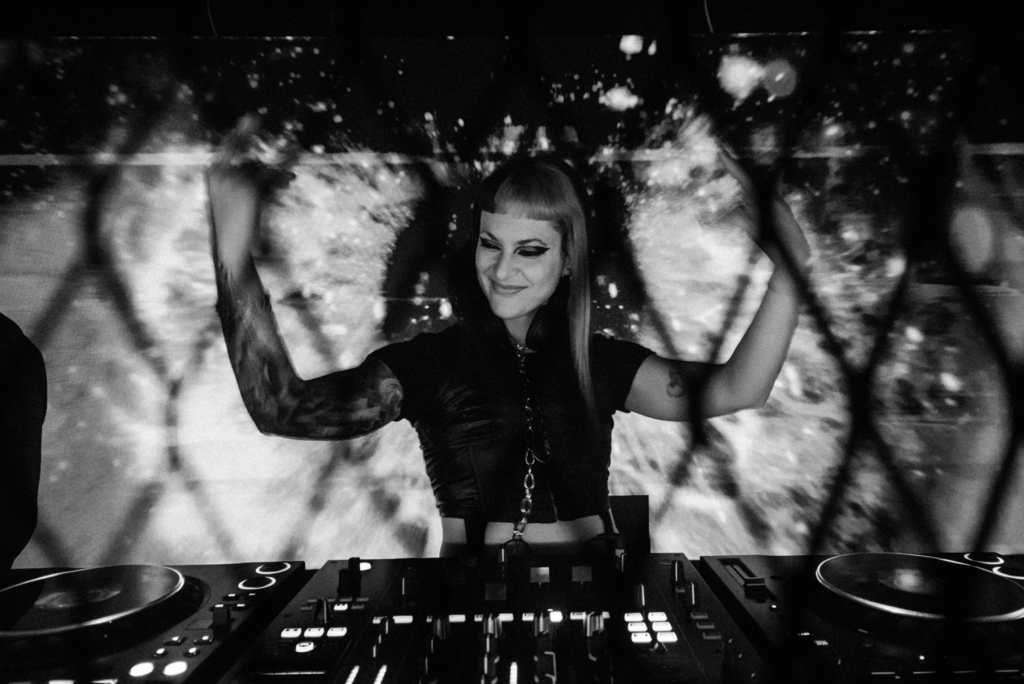
Behind all of this is Carmilla Sioux, a key figure and driving force of the project, continuing to push dark electronic music from Barcelona with a very clear idea of what should be happening on the dancefloor.
We spoke with her at an important moment, right as the record sees the light.
Index
1. Identity and origin
What does “From Hell To Disco” represent?
From Hell To Disco represents a transition, an emotional and sonic journey.
It speaks about that path that goes from the most introspective darkness to the collective catharsis of the dancefloor, from “hell” understood as internal conflict, intensity, rawness… to “disco” as release, communion and celebration.
It started as a podcast platform, with the intention of building an archive, providing context and creating a curated space for sounds that don’t always have a place in the immediate.
Then it evolved into events, because music needs a body and a physical presence. And later it became an independent label, as a natural way to close the circle: not only to showcase, but also to produce and sustain projects in the long term.
But beyond formats, From Hell To Disco is a meeting point. A space for people who share a sensitivity for dark, emotional and intense sounds; people who experience music not as background, but as something transformative. It’s a community that understands the dancefloor as a ritual, art as a language and music as a real form of connection.
What matters is not the image it projects, but the energy it generates and the consistency it maintains over time.
Barcelona has always had a dark scene, but also a lot of pose. Where do you place yourself?
I’m not interested in belonging to a circle or validating my work through a specific scene. I’m interested in building something that makes sense over time.
Barcelona has real talent, that’s undeniable. There are artists with strong sensitivity and honest proposals. But it’s also a city where aesthetics sometimes weigh more than content. There’s a lot of image, a lot of superficial narrative, a need to belong or fit into a label.
I try to work from a different place. From content, from consistency, from process. I care more about what it sounds like than how it looks. More substance than form. I don’t believe in fast hype or closed-circle dynamics; I believe in steady work, a clear identity and a community that grows organically.
Whether that places me inside or outside a scene is not something that concerns me. I prefer the project to speak for itself.

2. From El Raval to Upload
What does El Raval have that no other neighborhood does?
El Raval has friction. And friction creates culture. It’s a neighborhood where very different realities coexist within a few meters: history, migration, art, decay, tourism, resistance. It’s not a comfortable or “clean” environment in a symbolic sense, and that’s exactly why it has character.
The early parties there had something you can’t really explain. The space, the people, the energy of the neighborhood… everything played a role. In El Raval, things happen because they have to happen, not because they’re planned for a photo.
That controlled chaos, that constant mix, creates an authenticity that’s hard to replicate in more neutral environments.
Was the move a natural evolution or a need to grow?
It’s mainly evolution. When a project starts, what it needs most is intensity and closeness. But if it wants to survive, it needs structure. If it doesn’t grow, it stagnates; and if it stagnates, it starts repeating itself.
The move to Upload isn’t about an empty ambition to “get bigger,” but about doing things better. Better sound and production, better conditions for both artists and the audience. Being able to take care of details without losing the essence.
Growth doesn’t mean betraying your origins.
Do you lose something when leaving the physical underground?
You lose a certain kind of romantic precarity. That feeling of doing something fragile, almost clandestine, that could disappear at any moment. And that has its charm.
But for me, the underground isn’t defined by the size of the space or the budget. It’s defined by intention, by the honesty behind the project. You can be in a basement and still be superficial, or in a bigger venue and remain radical in your approach.
The underground is an attitude, not an address.
What changes when moving to a more institutionalized space?
The structure changes. There’s more responsibility, more visibility, and also higher expectations. It’s no longer just about energy, but about management, planning and professionalization.
That forces you to be more rigorous and to think long-term, where every decision can impact your reputation.
But with that responsibility also comes stability. And with the right stability, creativity no longer depends on chance.
3. Inferno Vol. 1
How much of you is in “If You Dare, I Burn”?
There’s more than it might seem. “If You Dare, I Burn” is about tension, desire and confrontation, but not only in a romantic or physical sense. It’s about not doing things halfway. About accepting that if you step in, you go all the way.
The track has that contained energy that could explode at any moment. And that connects a lot with me: that duality between control and overflow. It’s not a comfortable piece. It’s direct, there’s no middle ground.
It’s not a track I made to please, but to provoke a reaction.
Aesthetic curation or personal affinity?
Aesthetics first. Always. If there’s no sonic coherence, the project falls apart. Inferno has a clear identity, and not everything fits within it. Curation is a way of respecting the concept.
But then comes personal affinity. Because a label is not just a catalogue; it’s a network of relationships. If there’s no mutual respect, shared vision and a certain level of connection, it shows. And in the long run, that affects the result.
What defines the sound of Inferno?
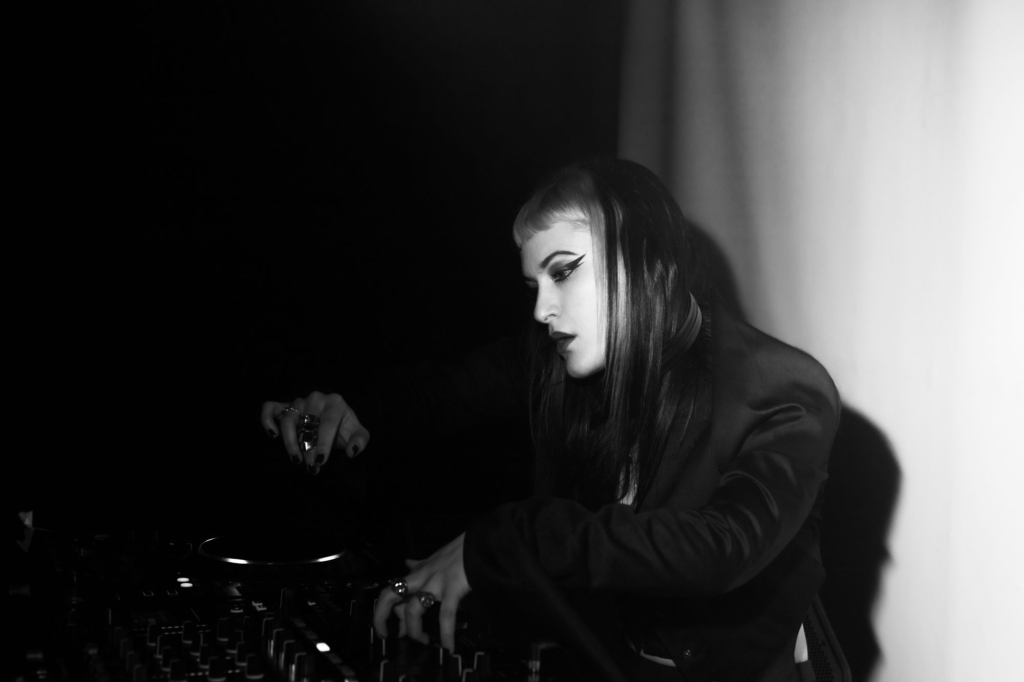
EBM and industrial as the backbone. There are moments of new beat and dark techno that introduce movement, sensuality and a certain hypnotic quality for the dancefloor.
It’s a physical sound. It’s designed for the body, for the club, but also to create a dense, heavy atmosphere.
With Inferno, what I was looking for was intensity.
What does From Hell To Disco bring to the scene?
It’s not just a series of events or isolated releases. It’s a narrative that connects podcast, parties and now the label. There’s a consistency that runs through everything.
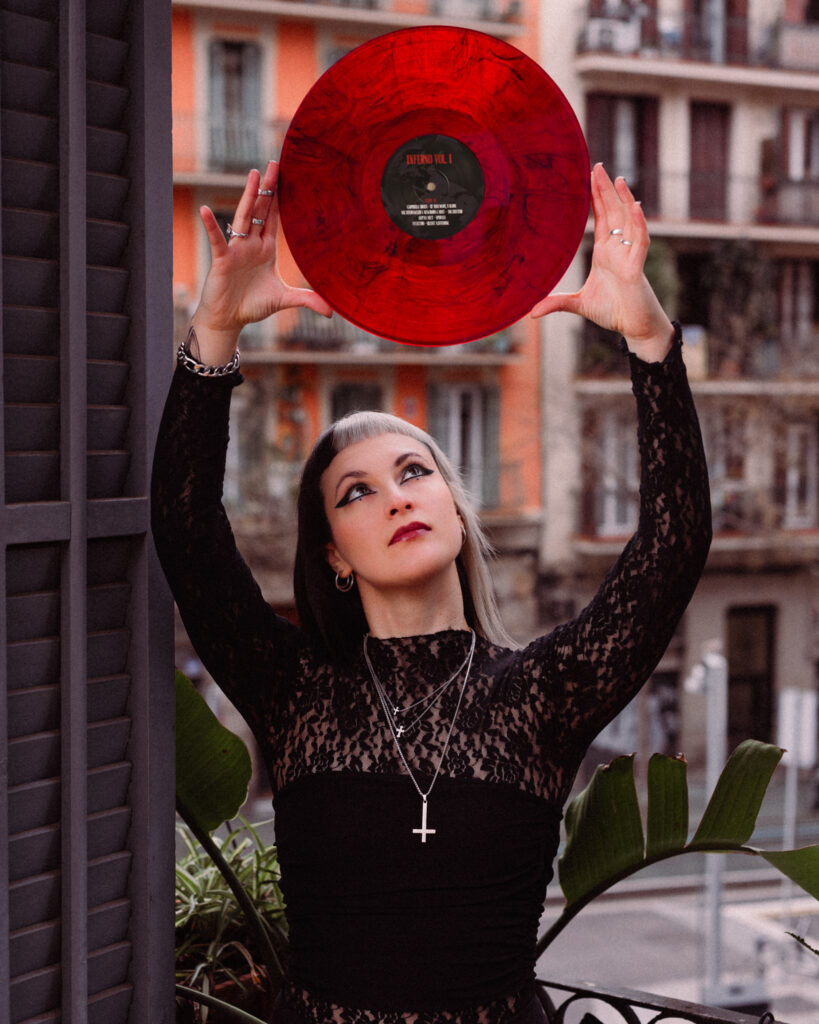
It brings community, because it’s not only about booking artists, but about creating a space where that sensitivity finds a home. And now it’s also a physical object. The vinyl materializes that vision, turning this identity into something you can actually hold. A way of saying: this exists.
Vinyl: romanticism or strategy?
It’s mainly about love for the format. Vinyl is not the most convenient or the most profitable option. It’s slower, more expensive and less immediate. And that’s exactly why it matters.
It’s a conscious decision. Vinyl forces commitment. It’s not a file that gets lost in an endless playlist. It’s an object you choose, place, and listen to. It has weight, it has ritual.
In a context where everything is instant and disposable, choosing vinyl is a way of saying that music deserves time and attention.
4. The current scene
Is it at its peak or fragmented?
It’s fragmented. There’s talent, a lot of it. The level of production has improved, there are solid proposals and artists with a clear identity. But that talent is divided into micro-scenes that often don’t really connect with each other.
There are small, very defined circles, whether by aesthetics, affinity or spaces that almost function like bubbles. Sometimes there’s more competition than collaboration, even if it’s not always explicit.
I don’t think it’s the worst moment, quite the opposite: there’s raw material. What’s missing is more cross-conversation. More bridges.
Is there a real sense of community?
Yes, but as I said before, it’s fragmented.
Within each circle there is support, there is loyalty. That’s positive. But the problem is that those communities don’t always intersect. There’s a lack of exchange between audiences, more unexpected mixes, more spaces where different sensibilities can coexist.
The ability to create dialogue is what we can call a real community.
What is the scene missing?
More genuine collaboration and less silent competition. That’s the key.
Less comparison and more collective building. Sometimes the energy goes into positioning, into measuring who stands where, instead of thinking about what can be created together.
The scene would grow much more if it understood that adding doesn’t dilute identity, it strengthens it.
Interesting local artists?
There are several names contributing from different angles:
Newborn Ghost, Asymetric80, Jessica Bellomo or Nightcrawler, just to name a few.
They’re very different profiles, but all of them bring character. And that’s what matters most right now: having a clear identity.
5. The uncomfortable side
Worst place you’ve played?
More than a specific venue, the worst experiences have nothing to do with the space itself, but with the energy. It’s those places where you feel that music is just background noise, not the center of what’s happening.
When music is treated as decoration, everything is lost. DJing stops being communication and becomes atmosphere.
For me, the dancefloor is a dialogue. If there’s no listening, there’s no connection. And without connection, the experience feels empty, no matter how good the booth or the sound system is.
Have you ever felt undervalued?
Yes. And I think many women behind the decks have felt it at some point. Sometimes you have to prove twice as much to be taken just as seriously. Your judgment, your technique or your authority get questioned more. These are subtle things, sometimes invisible, but constant.
Over time, you learn not to seek validation. You let the work speak for itself. And you also understand that this pressure, even if unfair, forces you to be more solid, more precise and more aware of your own value.
It shouldn’t be like this, but that experience also shapes you.
What’s the fakest part of the nightlife scene?
Transactional relationships. When interest replaces artistic respect, the connection lasts exactly as long as it’s useful. At night everything feels intense and close, but often that closeness is more strategic than real.
You can tell when someone approaches you out of genuine affinity and when they have other intentions. And over time, you learn to see the difference.
6. Aspirations
Where would you like to play?
I’d really like to play in South America. There are people there who have been following my work for a while, and I feel there’s a real connection waiting to happen. They write to me, share the music, and understand what the project is about.
South America has a very particular intensity on the dancefloor. There’s an emotional commitment that really attracts me. I feel like it would be an honest exchange, not just another date on the calendar.
More than a “strategic” destination, I see it as a natural encounter that hasn’t happened yet.
Dream collaborations?
More than specific names, I’m interested in dark collectives with a strong identity. Projects with coherence, with their own narrative, that are not defined only by aesthetics. Being aligned and sharing a conceptual affinity.
Taking From Hell To Disco abroad?
Yes, definitely. The idea is for it not to depend only on Barcelona. There are plans to bring it to Berlin and South America. Berlin for context and sonic affinity, and South America more for the emotional connection and its community.
7. Closing
What would you like to have changed because of your work?
I’d like to see more space for dark projects with a clear identity.
Less fear of being dense, of being emotional, of being radical in a vision. Too often, darkness gets softened to make it more digestible. I’m interested in the opposite: creating room for what is raw, deep, and not always easy.
If something changes because of what I do, I hope it’s this: that more projects dare to hold onto their identity without asking for permission. That consistency matters more than trends.
What does “the ritual” mean?
The ritual is the moment when the dancefloor becomes a shared experience. When the DJ and the audience are not on opposite sides, but part of the same flow. There’s listening, there’s commitment.
The ritual doesn’t depend on the size of the club or the lineup. It depends on intention and collective focus. It’s an almost hypnotic state where time distorts and music stops being just sound and becomes shared energy.
That’s where everything makes sense.
The next step for From Hell To Disco
Thanks to Carmilla Sioux for her time.
Inferno Vol. 1 is now out. Now it begins its natural journey: being played in DJ sets, in headphones, and in venues where this kind of music still matters.
What’s interesting here is not just the release itself, but what’s behind it. A clear way of understanding the scene, selecting sound, and building something with continuity.
At Other Voices, we’ll be paying close attention to what comes next. Because if there’s one thing this conversation makes clear, it’s that this doesn’t stop at a compilation.
