Between Beers and Confessions: Sarcoma
Before diving into the deep conversation we had with Luna, there was a moment beforehand that I can’t leave unmentioned. Between beers and laughter, she revealed that more relaxed and human side that is sometimes hidden behind the lights and shadows of her music. The conversation flowed naturally, touching on many topics without filters. It was an easygoing moment that anticipated an equally intense and sincere interview, where Sarcoma held nothing back.
What is SARCOMA? Can you describe its essence and what inspired you to create this project?
Sarcoma is my experimental music project, more specifically noise. It started because I was already involved in many projects like La Profecía or Dunkelwald, and I needed to explore a way of making music without any censorship. I wanted to make music that felt unpleasant and dive into the world of noise that I felt was missing for me. After years of producing bands, I often found myself drawn to the parts of recordings that weren’t “right.” I liked the imperfections. That’s where Sarcoma comes from.
Your music is described as an emotional journey. How do you channel personal experiences into your sound?
I think my music is very emotional. It’s almost like hunger art. It’s not music that sounds “nice” or that can be enjoyed without connecting to those emotions. That’s why I often sacrifice sound quality in favor of intensity.
For example, when I recorded the vocals for the last album, I put myself through a kind of mental torture. I recorded them all in one go, using analog hardware, fully living the experience of what the record was transmitting to me. In exchange, the vocals don’t sound polished. They’re raw, visceral. But that was the point.
What artists or genres have influenced your sound the most?
I have many influences. For harsh noise, Merzbow introduced me to that world. In Sarcoma, the electronic side draws inspiration from Aphex Twin. I’ve also been influenced by how Soft Moon blends industrial and EBM, or the power electronics approach of Pharmakon. For the latest EP, Fotocopia was a major influence.
You mentioned that creating music helped you cope with cancer and the loss of a loved one. How did those experiences shape SARCOMA’s sound and themes?
My dog died of sarcoma in 2021. At that time, I wasn’t making music at all. The only way I could deal with it was by returning to the scene. I started working with La Profecía, Mendigo, and other bands. The idea of creating a project in her honor, reflecting the pain I felt after her loss, stayed with me until I finally did it in 2023.
SARCOMA is described as a channel to transmit femininity from a devastating perspective. Can you elaborate?
There’s something about how femininity has been approached in punk that I’ve never liked. It often stays at the surface level of reivindication. It’s not visceral. It doesn’t fully address the suffering that comes with being a woman — and in my case, being a trans lesbian woman.
I’ve drawn a lot from 90s industrial concepts, from Nine Inch Nails and that lost generation pain. Many of my lyrics, whether poetic or abstract, aren’t superficially reivindicative. The reivindication comes through the pain that being a woman carries.

You’ve been part of the extreme music scene since you were 14. How did Madrid’s squat scene influence you?
I started making black metal in my bedroom at 14. Then I formed my first bands, including crust and post-punk projects before 2020. Through that, I became involved in Madrid’s squat scene.
There I found political and chosen-family bonds that I deeply miss. It had its good and bad sides, but it gave me a platform to make my first musical mistakes — to do everything wrong before learning how to do things right.
You’re involved in several projects. How do you balance everything?
I’m always involved in many things because music is my job, even if I can’t live from it yet. Sometimes it feels like I’m only halfway present in each project. I’d love to dedicate 200 percent to one thing, rehearsing all day because I’m paid for it. But reality is different.
How has self-management shaped your production approach?
I have no formal studies in music or sound. That forced me to learn everything myself. I started producing, recording, and mixing because no one else was going to do it for my projects. Also because I couldn’t afford it.
Without systematic training, I began embracing what noise transmits. I kept the “mistakes.” I made messy recordings that felt beautiful and emotional. That’s something I still explore today.
Your debut album NOT CROSSES has been described as your personal “Downward Spiral.” Can you expand?
I started Not Crosses at the end of 2023 after returning from Finland with Dunkelwald. I was depressed again, back on medication. During that period, I wanted to pour everything into that project.
It was composed in two or three weeks. I used automatic writing, which revealed the emotional process I was going through. I recorded it quickly. It’s a snapshot of those terrible weeks and how I climbed out of that hole.
How do you translate that raw intensity into live performances?
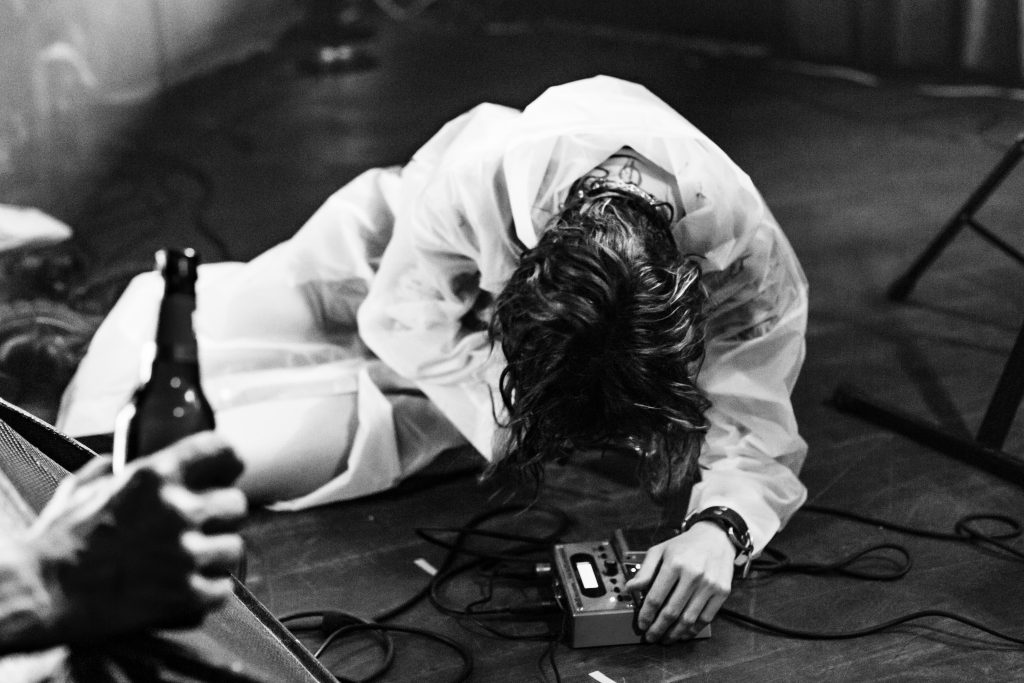
Live isn’t about perfect sound. It’s theatrical. I DJ the electronic parts while performing vocals live. I also use pedals and noise layers as a third instrument, adding extra unpleasantness and viscosity to open space for connection with what I’m feeling.
How do collaborations influence your music?
Collaboration has helped me learn from different perspectives. At first, I only did a few remixes because no one knew me. Now I have a full collaboration album ready to release. From now on, I want most of my work to involve collaborations. If I want to explore a niche genre, I’d rather work with someone who already lives in that space.
What’s next for SARCOMA?
I have three or four releases ready. I also recorded an album with Gala (El Piti de la Suerte) called Distorsionando la Tensión. I’m very proud of it.
You once said, “Either I make music or I kill myself.” How does that shape your process?
With Sarcoma especially, I embrace arbitrariness. In noise, everything is valid. I’m less perfectionist. I just want to create, perform, explore how noise can make people feel.
So yes, either I make music or I kill myself. I don’t conceive of another way to live.
Is there something you’d like to share with your audience?
I don’t fully understand if I have fans, but apparently I do. I’ve been writing the second part of the fanzine I started a year ago, and I’m excited to share it.
About the guest lists for trans people?
The idea came from Föllakzoid. I think it’s brilliant. There are far too few trans people at concerts. The message is that venues and shows are also their space. At my performances, they are the ones who matter. Cis people need to understand they are guests in that space. It’s not positive discrimination. It’s a statement that this is a legitimate space for someone who may not fit your binary vision of gender. They don’t have to stay home.
Have you felt discriminated against?
I haven’t experienced direct discrimination recently, maybe because I “pass.” But I suffer discrimination for being a woman. I’m constantly pressured to fit into a hegemonic image of womanhood, to hide the fact that I’m not cis. That obsession with image — especially when I’m the only woman in a group — is exhausting. No one is really like that.
Thank you, Luna, for such an incredible interview.
Thank you, Other Voices. Thank you for this space. Thanks to everyone.