New videoclip from Soft Riot
Soft Riot has released the video for Ghostwriter, the second track from Crux to get official visuals, and it runs against nearly everything a music video is expected to do today. There is no performance to camera and no story with a beginning and an end. What the viewer gets is printed paper figures, cut out and moved by hand, set over backdrops that were projected and then filmed again. Jack Duckworth, the Canadian musician based in Glasgow and credited as JJD, put it together between August and September this year, and every frame keeps the trace of those hours at a table with scissors.
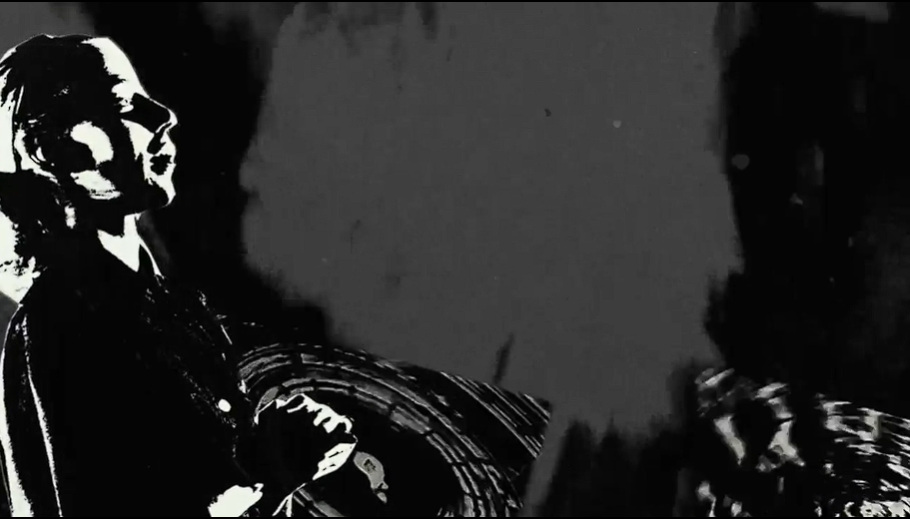
Soft Riot without a face: a paper singer with a cut-out mouth
The video opens on a silhouette whose head turns into a mask of concentric spirals. Fast cuts follow: a man in a suit, veiled figures, stone busts, speckled masks, all over a flicker of scanlines. This is cut-out animation in the line of Terry Gilliam, with one important difference: where Gilliam went for the gag, everything here moves with a straight face, and Soft Riot’s roots in the 1990s hardcore scene show in the taste for the photocopier and the fanzine.
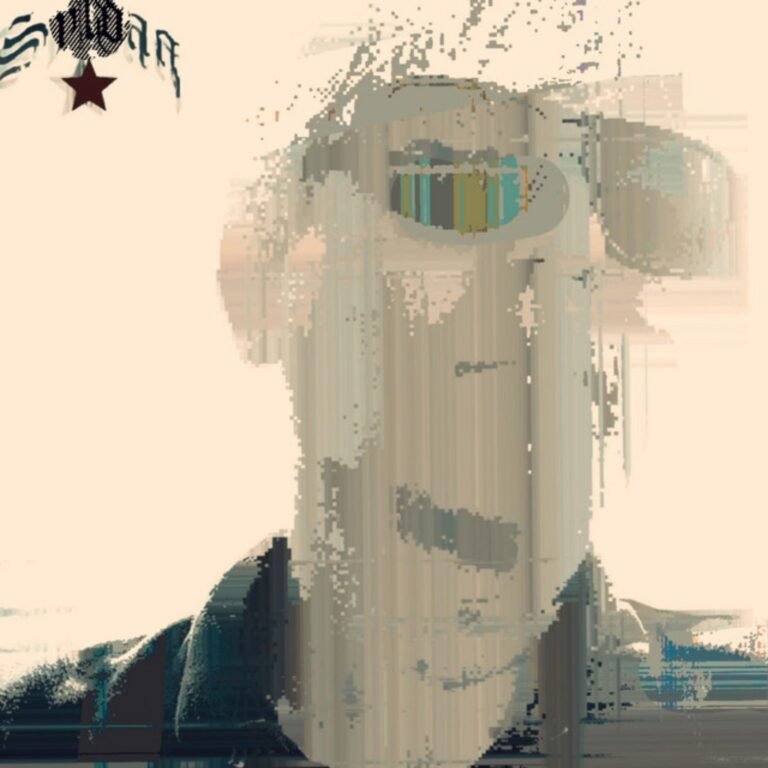
The central character appears in the first verse: Soft Riot in dark glasses with angular hair whose mouth is a horizontal slit that rises and falls with the voice. It is the best idea in the video. The mechanism is elementary and it works because it matches what you hear, a low, dry, near-spoken voice with a slight electronic doubling that sounds like a machine before it sounds like a person. The cardboard jaw and the synthetic baritone say the same thing by two different routes.
Hammer, Amicus and a song in two halves
Underneath the voice sit a mid-tempo drum machine, an analogue bass that never leaves its spot and bright arpeggios, with lead lines bent downwards in pitch. The economy of means and the deadpan tone point to Fad Gadget. The theatricality comes from somewhere else: the lyric rhymes with a stagey relish inherited from the Hammer and Amicus horror films of the 1960s and 70s, and the baritone sounds like the narrator of one of those pictures run through a synthesiser. It describes someone who feels another mind writing their sentences, and the chorus repeats the word ghostwriter until it moves into the room.
The structure is less obvious than it looks. The first two thirds alternate verse and chorus, and around 3:09 the track shifts gears into a third part that had not appeared before and stays until the end. Soft Riot has used that trick on earlier records, and it works because nobody announces it.
The music video as a cutting machine
The cuts follow the snare and the synth accents with a precision that rarely slips. In the choruses the edit speeds up and stacks coiled snakes, suits of armour, marble busts split and rotated, a woman in a metal helmet, punch cards drifting across the singer’s face. Each image lasts just long enough for the eye to recognise it and lose it, and it works the way the chorus works in the song: through insistence. The second chorus, though, gathers every motif into under thirty seconds and plays more like an inventory than an argument. Snakes, armour and busts are standard vocabulary in surrealist collage, and nothing here sets them apart from anyone else’s.
Made by hand
Soft Riot frames the video as an answer to a scene that increasingly resembles a spreadsheet of statistics, and to the feeling of working alone, with the same hands on the music, the graphics, the videos and the promotion. Hence the physical animation made in a real space, the help of other people and software reduced to keying out backgrounds, adjusting levels, colouring and layering. He does not reject the digital: he holds that it rests on the physical world and wants to give priority to the latter. It is a coherent position and the part of the project that most deserves respect.
The closing credits record it, and the grain and uneven edges confirm it on screen. The video does not need to show hands for us to believe there were some. What it does not do is explain the why: a viewer with no further context gets a collage with physical texture, and the isolation and the community are a reading you have to bring from outside. It is a legitimate choice, because the video works just as well without it.
There is one reading in its favour. The song is about an invisible mind writing the lines, and the video refuses to show it: the figures are puppets with no hand in sight. If that absence is deliberate, and everything suggests it is, the video does say something about the song.
Other Voices verdict
Ghostwriter is a video with a solid formal idea. It works thanks to the Soft Riot’s cardboard mouth and to colour doing the work of structure. t carries a second chorus that has turned into an inventory. It places Soft Riot well at the moment of Crux: an artist with fifteen years of craft in synth post-punk who uses every piece of a release, the image included, to say what music he wants to make and how
It ends with white credits on black, the recording of the album in Glasgow, the mixing in France and one last blow: the paper head opens its mouth slit again and lets out with Vincent Price’s laugh on Thriller before the final cut. It is a small joke, well placed, and the best proof that the author does not treat his own edit with solemnity. Anyone who knows Crux will find a good companion piece to the track. Anyone arriving without it has a reason to hear the album.