Nico Amara’s Punishment Machinery review
Nico Amara releases Punishment Machinery, her second full-length, and with it moves further away from the darkwave she started from. The Swiss artist had long wanted to set Dante’s Inferno to music, and she has solved it by taking things away: there is hardly any melody and hardly any instrumentation, and what remains is a drum machine, a digital bass, layers of noise and a voice that rarely rises above a whisper. Nine tracks in Italian, English and French, made to be heard in order, from start to finish.
Nico Amara and Hell as machinery
The method explains the result. The lyrics were written for specific passages of the Inferno before the music was finished, so the running order was fixed from the start and the sounds had to fit around that sequence. You can hear it. The album unfolds like a story, with its threshold, its descent and its way out, and not like a collection of songs sorted afterwards. Nico Amara moves through selected circles, from the dark wood to the end
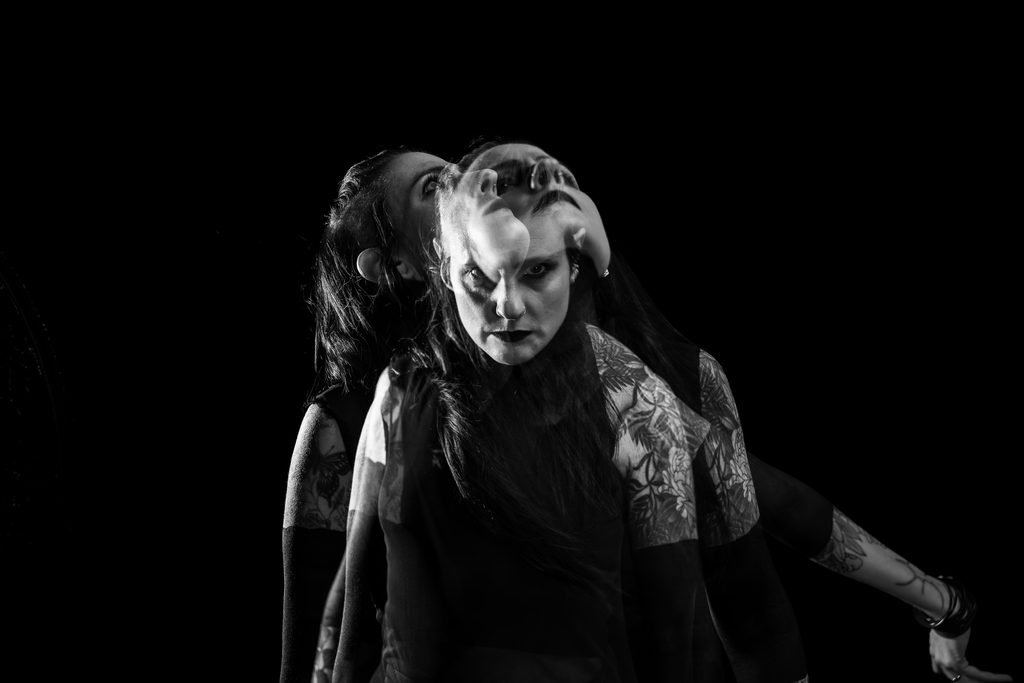
The idea of Hell as an apparatus of punishment is in the form as well. Mechanical rhythms that repeat, melody cut to the minimum and a layer of noise with an almost physical weight. Everything sounds dry and restrained, and that restraint pushes Nico Amara’s darkwave foundation into post-industrial territory.
Amara writes, performs and produces the album. The mixing and mastering are by S. Templeton at Influx Studio, and the cover art is hers too. Punishment Machinery came out on 13 November digitally, with CD and cassette editions through Violet Hour Transmissions.
The nine tracks, in order
Inizio dalla fine opens with a mechanical rhythm and Nico Amara’s voice whispering in Italian. The lyrics speak of starting from the end, of having no face, of a threshold opening. The track is linear: it neither rises nor falls. That decision sets the register for everything that follows.
Non-arrival begins with a hum of static. The percussion comes in slowly, like a heartbeat, and the track hardens until it turns industrial. The English text is about distance and absence, about a door that cannot be closed once it has been opened.
Hate holds the line. Arpeggiated digital bass, a faster rhythm and a voice whispered even lower than in the two previous tracks. The phrases are short and dry, and the hatred is repeated until it becomes rhythmic material.
Non-Believer starts with a distant, muffled industrial kick. The very dark keyboards give the track its strength and the small glitches fill the space. The voice stays in step with the rest of the album, never leaving its lane.
Unbecome lets some light in. The synths are brighter than anywhere before and the voice takes on a more sung register. The pace is still slow, but the album breathes for the first time.
Burn changes speed. The kick is pure techno, hammering, and the other elements come in with the same insistence: minimal EBM, to coin a genre, if it didn’t already exist. The voice is muted again. It was the first single, released on 25 September, with an official video in October.
Call in masks is the sparest track. Minimal percussion that sounds like drops of water, a keyboard layer and a voice with reverb, far more narrative. It is the closest the album comes to chamber music.
Fading was released as the last single on 30 October and is the most danceable track. It does not abandon minimalism, but it has a better groove and the vocal delivery turns percussive. It draws on the Ninth Circle and betrayal, and the ice in the lyrics, with its body locked and unmoving, fits the punishment of that circle.
At the end of it all closes at a high tempo, with lyrics in French and the last line in English. Its sounds recall the most industrial period of Depeche Mode, somewhere between Construction Time Again and Some Great Reward, and it is very catchy. As I write this, my head and feet are moving on their own. The lyrics climb out of the ice and the broken body and are left with a single thing standing: hope.

Other Voices verdict
Punishment Machinery is a narrative album that deserves to be heard whole and in order, picturing Dante’s Inferno while it plays. It is very minimal, with few instruments and no jolts, made for quiet listening. Anyone looking for peaks of intensity will not find them. What Nico Amara offers is a tense, continuous line that only loosens in Unbecome and Call in masks, and that finishes with rhythm in Fading and At the end of it all.
The central tracks share their tools: whispered vocals, sombre keyboards, a kick or a bass line that sets the pace. They are told apart by detail and not by impact.
There is a curiosity about how Nico Amara will present these tracks live. They are easy to imagine with very powerful visuals, and the album gives plenty of material for a staging that matches the concept.