Vitorio Testa · Interview | Barcelona
There are DJs whose names you find on posters for fifty-thousand-capacity festivals, and there are DJs whose names you find on flyers pinned to the walls of the right bars, passed between the right people. Vitorio Testa belongs firmly to the second category, and that’s not a consolation prize. For nearly ten years he has been one of the quiet architects of Barcelona’s darkwave and underground club scene, moving between the Virus parties, Nocturna Festival, the Manchester, Italo Moderni, and the intimate Dolce KoKcoro sessions where Japanese city pop and italo disco share a floor without anyone finding it strange. His sets have personality because he does. We sat down with him at home, surrounded by records. Here is our interview with Vitorio Testa.
For anyone who doesn’t know you yet, who is Vitorio Testa, and how did your relationship with music begin?
The name Vitorio Testa hasn’t been around for that long, actually. I started my DJ phase calling myself Mr. Hitchop. I’ve been playing out for almost ten years now, more or less. It all started through going out on the Gothic scene, which was where I first got moving, mainly with my older brother and his friends back in the Demonix days, the early Viruss parties, Nocturna Festival. From there I was always watching the DJs, the work they did in the booth, how they made people dance. One day I just thought: “Why couldn’t I do that?” I already played instruments, music was already part of me, I played guitar, I had bands with friends. So I started practising, and here we are.
A lot of DJs start as collectors or compulsive record hunters. Was that your path too?
More or less. I started collecting music, but mainly CDs. I remember my first CDs, bought in Tallers, in the legendary shops everyone knows. I’d go with my friends at fifteen, sixteen years old, straight from school, down to Tallers or Hospitalet, some shops out that way or La Farga, but mostly Barcelona. We’d come to Tallers and buy CDs, go to Revólver, to Discos Castelló. Then later I started getting some records too, but always just for the music, for the collection. It wasn’t like now. Once you start actually DJing on vinyl, it becomes a compulsion, “I need that record, I need that twelve-inch.” That came later, once I’d properly started playing out.
Do you remember the first time you played in front of people? What was going through your head?
Yes, that was almost ten years ago. The first person who invited me to play was Dan Martin, from Barcelona Depeche Mode Fan Club. It was a Depeche Mode versus And One night at Demonix. I was a bit nervous, honestly. I’ve always been grateful to him for that, he knows it, and every time we’ve played together since we talk about it, it was a very special moment for me. And it was funny, because right when I started, something wasn’t working on the desk, no sound coming out, the typical first-time thing. Turned out the crossfader was in the wrong position. We moved it, everything came through, and I was like: “Wow.” Good feeling. I remember it perfectly.

Vitorio Testa tends to come up in connection with sets that have real care and personality behind them. How would you describe your approach?
My sets are pretty varied. I don’t like playing linear sessions in the classical sense. I know that right now the dominant model, especially in techno, is total consistency from first track to last, and I genuinely respect that, it’s not easy, and there are people who’ve been doing it for decades who are miles ahead of me. But it’s not what I want to do. I like to vary it. People who know me know that. It also depends entirely on the room. Playing the Manchester is different — it’s a familiar, underground space that gives me latitude: I can open with post-punk, drift through indie, put on some rock, then italo, then electronics, then techno. When I prepare something more specific, for a label event or a particular party, I do put more structure in. I try to make it cohesive, but not boring. Even within a prepared set, I want to be able to move.
Within the darker universe (darkwave, post-punk, coldwave, EBM, even italo) which styles do you most enjoy playing?
I love it when I can drop a classic italo track in the middle of a set. I rarely do pure italo sessions, to be honest, it’s also hard because not every crowd goes for it. But what I mostly play is a lot of italo sound, EBM, New Beat, darkwave. I always listen to everything, I like discovering different things. I also do the Japanese music sessions with Stacy, we mix Japanese music and italo disco together. The styles I work with most, if I had to name them, are darkwave and EBM, which makes sense given where I come from: growing up in the Gothic scene means you absorb a lot from that whole dark world. But I always try to put in something that isn’t strictly darkwave, something to shift the rhythm of the set while keeping that thread running.
Every DJ has that one track, the one you know will change the room the moment you drop it. What’s yours?
As a DJ, you usually have several, not just one. You always have a few aces you can play to close a set or drop in between: really iconic tracks, or tracks that aren’t that well-known but you know will land. Some of my favourites are things from Nitzer Ebb. But there’s one track I’ve used more times than I can count to close: I haven’t dropped it as much recently, but I love it, “Fotonovela” by Ivan. It’s a track a lot of people already know, it’s a classic, but it has this very nostalgic feel to it, very italo, and at the same time very pop. Every time I play it, the people who know it have that moment of recognition. It works every time.
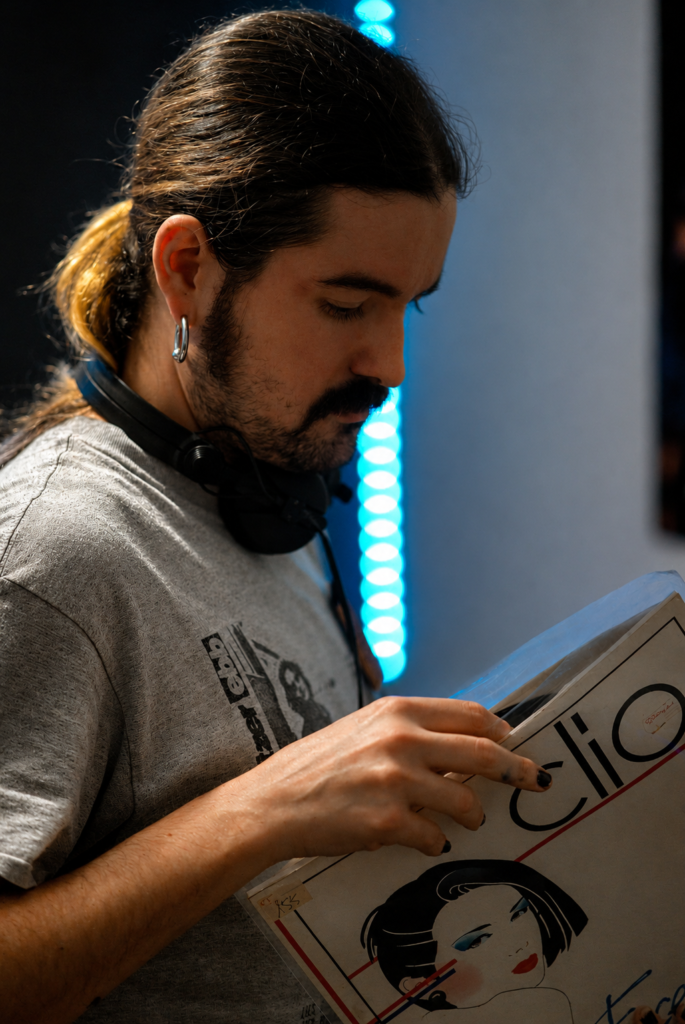
And then there’s one I don’t play that often, but it was one of the first expensive records I bought when I started collecting: “Faces” by Clio. A legendary track, the cover alone is iconic. This is an Italian first pressing. An absolute gem.
Post-punk and darkwave are experiencing a real boom, but there’s also a view that too many current bands sound alike. Is the scene evolving or just recycling the past?
The scene is evolving, no question. But we also know that creating a genuinely new sound today is hard — creating a new style. So everything ends up being, to some degree, a recycling of sounds that already exist. The saving grace is that new artists keep appearing, people who experiment, who try things, who take an existing framework and add their own specific touch, a particular voice, a particular synth sound. I do think it evolves. Even if everything in the darkwave world can sound similar, each band has its own point, when you connect with one it’s because there’s something specific there, something that makes you say: “This reminds me of that, but it has its own thing.” Personally, I haven’t played in a band for a while, and I’d like to have my own project eventually. But the fear is exactly that: if you’re going to do it, you want it to have your own mark, even if it draws from other sounds and styles.
Today most people discover music through playlists and algorithms. Does the DJ still matter as a tastemaker?
I think so, because when you go to a session you always discover something new. You’re watching a DJ and you think: “What is this track, this is incredible.” You try to Shazam it and Shazam doesn’t pick it up, we all do it, me included. That’s the magic of it, that moment of discovery. There are a lot of ways to find music now like Spotify, Tidal, artist radio stations that spit out hundreds of suggestions, and they work, I use them. But ultimately it’s the same as it always was: someone passing you a cassette. My cousins passed me my first tapes: Heavy Metal, Blind Guardian, Metallica. The DJ is that, in the end. Someone you trust pointing you toward something you hadn’t heard. The human recommendation, the face-to-face moment. When a record shop person says “listen to this” and you end up buying it, or going back to find it later. That direct connection between people always works.
When you prepare a set, do you arrive with a clear idea of what you’re going to play, or do you prefer to read the room and build it as you go?
A bit of both — which is sort of what I’ve been saying throughout. For a more specific event, a label night, Viruss, Nocturna, I do prepare: I decide which tracks I’m definitely playing, roughly in what order. I spend a few days beforehand searching, because every month I’m always looking for new things — new releases or old tracks I’m discovering for the first time. But then you always have to read the room. A DJ has to learn to read the floor. You have to know the right moment for each track, whether the floor is active, whether you’ve got enough people dancing to take a risk. You’re not going to drop “Blue Monday” for four people. The magic disappears if you stick too rigidly to what you prepared. When I was starting out I used to plan everything meticulously. But you realise: the magic is in improvising within a structure, in knowing when to step off the map.
— Especially if someone requests “Wild Boys.”
If someone requests “Wild Boys,” you blend it with Kano and you’re in. Perfect. (laughs)
You spend a lot of hours hunting for music. Where do you find the gems that end up in your sets?
Honestly, sometimes fewer hours than I’d like, between work and family, the studio sits closed for days at a time. But when I do have time, I go looking in record shops and digitally. I use Spotify a lot, even though plenty of people hate it — I understand why — but it’s genuinely useful for exploration: following a thread from artist to artist, running a radio, finding things you didn’t know existed. Bandcamp too, underground artists, digital platforms. There are a lot of options. The point is to keep the library moving, keep finding things.
We’ve heard you have a serious collector’s instinct beyond just records. What do you accumulate?
This is a wide field. I’m a proper hoarder, I’ll admit it. Apart from records, I collect signed things — when an artist I like comes through, I try to get them to sign something. I’ve got a lot of signed items. Curses, for example — the first thing he signed for me when he came to the terrace years ago. And then guitar picks — that’s a big one. I have whole books of picks from concerts and festivals I’ve worked. I spent three years working Resurrection Festival, which gave me a lot of material. Some of them have real value, sentimental and otherwise. And things from my trips to Japan: random objects, toys, anime figures, all my nerd stuff.
What’s the most unexpected or special find you’ve come across as a collector?
There’s one specific record. A friend told me a relative of his wanted to get rid of their collection, so I went over one day to dig through it. I took a pile of records home, and in the middle of them I found this: a first pressing of a Mortuary Drape record. First edition, 1992, All Witches Dance. Anyone who knows it will understand why that matters — it’s Italian death metal, it’s quite sought-after, it’s not in perfect condition but the moment I found it I thought: “This is a gem.” It’s one of the strangest things I own, completely outside what I normally play. My collection goes well beyond my DJ sound — metal, pop, electronics, I even have some reggaeton on vinyl, Japanese music. But that Mortuary Drape is probably the most surprising thing I’ve found.
What’s the most surreal or chaotic situation you’ve found yourself in while playing?
While playing, or on the way to play. The most chaotic thing happened last year — New Year’s Eve 2024 going into 2025. I was leaving my flat heading to play at a friends’ bar, Lily Sansons, where we had the New Year’s party. Getting into the taxi right outside my door, someone opened the boot and took my laptop, right as we were about to pull away. Even now when I think about it my heart rate goes up. I came out of the flat literally on the corner of Laietana, started running after them in full DJ clothes — jacket, boots, everything, through the back streets here. And by some miracle I chased them down, they dropped the laptop in an alley. By the time I stopped I was done, I couldn’t run anymore, and there it was on the ground. Went and played the gig, calmed down. But that was rough.
The other category of surreal is fetish parties — I’ve played a few of those, and you see things. People climbing into the booth and dancing right next to you. In that context it makes sense, but it qualifies as the most random thing I’ve witnessed.
Any projects you want to share with us?
The main thing I’ve been pushing is Radio La Testa, my radio events, which I try to do as often as I can. I always invite someone to play alongside me, usually just the two of us, and the sessions are varied within our style: underground, darkwave, EBM, but always with room to move. It can be anything from a vinyl-only set to something totally eclectic.
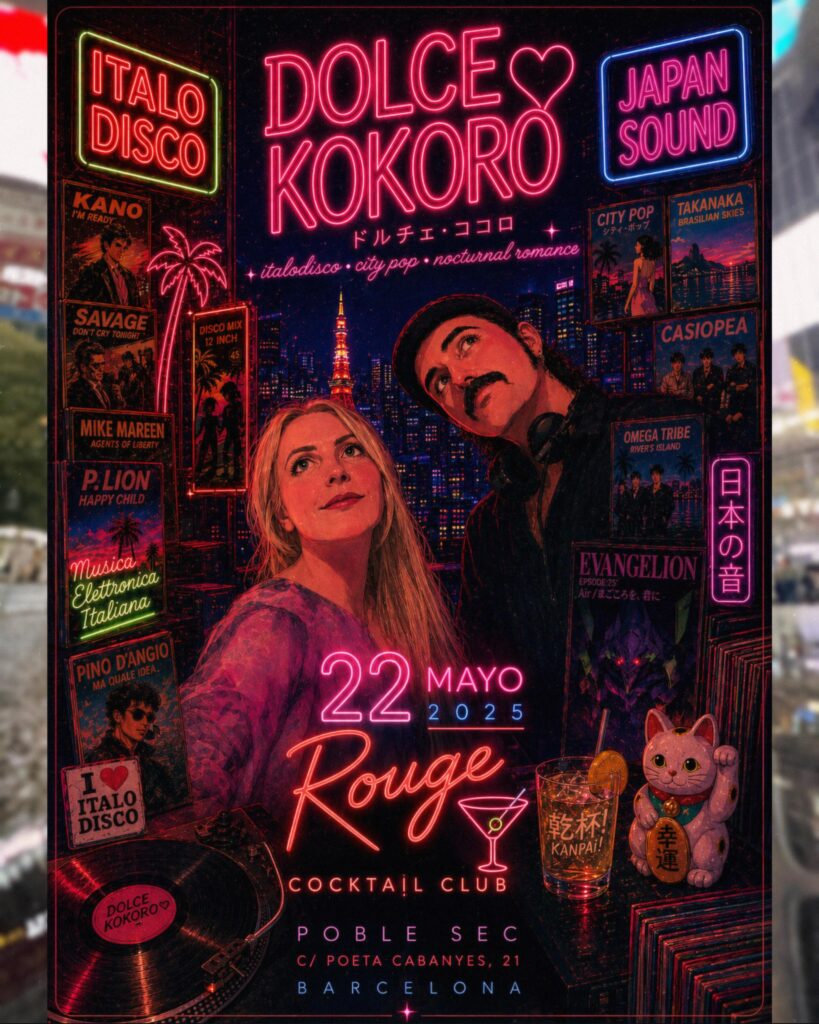
And then the project I’m doing with Stacy: Dolce KoKoro, Japanese music and italo disco sessions. We’ve done several events now, at Rouge, Freedonia. What we play is that blend between city pop, Japanese electronic music, italo, electro, early electronic music. They’re not club nights in the typical sense — they’re more about listening, having a drink, discovering these genres that most people haven’t really encountered. We try to do them in bars and cocktail spots rather than straight club spaces, though dancing is always welcome.
Vitorio Testa plays regularly across Barcelona’s underground scene. Follow his upcoming dates on his social media.