BLiTZ drag their masked mythology into the industrial metal debut Bitter Me
BLiTZ arrive with a mask, a science-fiction backstory, and a band of mercenaries behind them. This review of Bitter Me tries to separate that narrative packaging from the record itself: ten tracks moving between industrial metal, NDH and eighties metal, released on 12 June 2026 (Fastball Music) by a Boston outfit that has chosen to present itself as a resistance cell fighting a fictional world government, the GIO, set in the year 2066.
The premise is ambitious. BLiTZ is described as a former soldier, possibly a weapon built by the very regime he now fights, flanked by four commanders with comic-book military aliases: Sharpshooter Fade on guitar, The Mad Dr. Fuse on synths and electronics, General Maul on bass and Heavy Weapons Specialist Bane on drums. The 2066/GIO concept works as a marketing frame and as a lyrical thread, and that much it delivers.
The trouble starts when that framework begins competing with the music instead of serving it. Bitter Me is billed as the first in a series of “coded transmissions”, which points to a long-term conceptual roadmap. That’s a risky move for a debut: it asks listeners to buy into the universe before they buy into the songs. The record works best when it’s driven by instrumental execution rather than the mythology wrapped around it. It sags whenever a passage feels written to serve the script rather than the song.
Mechanical precision, human intensity
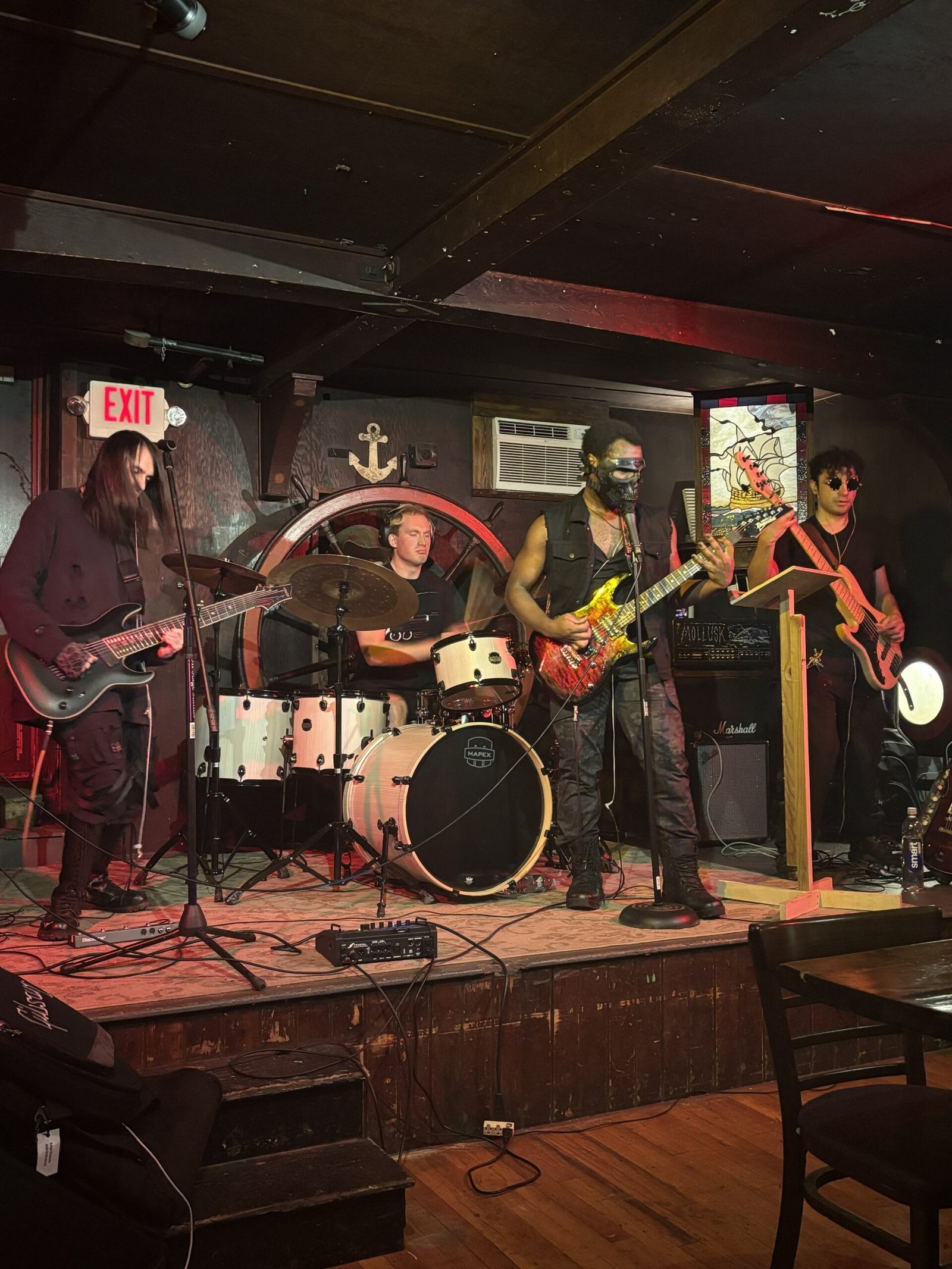
Musically, BLiTZ build their identity on rigid, near-militaristic rhythms, cinematic synth work and an explosive low end. The formula draws on classic industrial metal and NDH, with direct nods to eighties metal in the guitar work. The production favours clarity and weight over saturation.
BLiTZ’s voice is what holds the record together. He shifts between registers within the same track without losing cohesion, and that vocal range is arguably the album’s strongest asset, ahead of the instrumental work.
Track by track
“Blitzkrieg” opens the record staking out its territory, setting the direction for everything that follows. “The Score” and “Sudden Death” hold that pulse without springing any real surprises, functioning as connective tissue for the story this album is trying to tell.
“My Enemy” is the standout. It works as a semi-ballad on a record otherwise committed to full-force impact, and it’s here that BLiTZ’s vocal range gets the most room to breathe. It breaks from the militaristic pattern of the rest of the album without stepping outside the manifesto.
“Bitter Me”, the title track, holds the line without doing anything to distinguish itself, an odd choice for a song meant to serve as the record’s calling card. “Vermilion Vein” and “The Forsaken” stay within the established lane without adding much variation.
“Carnival” is the most industrial cut on the record, the closest thing here to a pure reading of the genre without the eighties-metal concessions found elsewhere. It’s also where Dr. Fuse’s electronics and synth work take precedence over guitar. “The Game” and “Take Me Alive” close the album on a steady note, with the latter working as a coherent ending rather than a climax.
The Other Voices verdict
Bitter Me is a solid debut within the established codes of industrial metal and NDH. It doesn’t reinvent the genre, but it executes with craft. The BLiTZ concept, the character, the GIO, the year 2066, gives the project brand identity and a long-term narrative that reads well on paper. What happens to this dystopia across future releases remains to be seen.
For followers of the industrial and NDH scenes, this is a debut worth noting, particularly for “My Enemy” and “Carnival”, the two poles of the record: the most human and the most mechanical. Everything else holds steady, which for a first album is no small thing.

Fer