Review of Nightcrawler’s latest work, Uranium 235
Uranium 235 starts from a question its author leaves written on Bandcamp: can an electronic album tell a story without words to explain it? Nightcrawler answers with nine tracks and a little over thirty minutes devoted to Chernobyl, on one condition he sets himself: listen from start to finish, in the order he imagined. Released on 5 November, after the singles Reactor 4 and System Lies.
Nightcrawler Uranium 235 and the Chernobyl disaster: the context
In the early hours of 26 April 1986, reactor 4 at the Chernobyl nuclear power plant, in what was then the Soviet Union, exploded during a safety test. The AZ-5 emergency order, meant to shut the reactor down, caused a power surge that destroyed the core and released an amount of radioactive material without precedent in civilian history. Pripyat, the city built in the 1970s to house the plant’s workers, was not evacuated until the afternoon of the following day. The Soviet authorities stayed silent for days, and the world found out what had happened when a Swedish power station detected abnormal radiation in the air. Then came the exclusion zone, and the liquidators who built the sarcophagus.
Almost every title on the album marks a point in that story: the city, the device that measures radiation, the reactor, the button, the evacuation. Anyone who doesn’t know the history will piece it together from the record. Anyone who does will find the order of events.
Radiation, Pripyat 1986 and System Lies with Carmilla Sioux: the disaster starts to sound
Radiation, the intro, lasts under a minute and already announces what is coming. Nothing more is needed: the disaster is in the room before the first proper track begins.
Pripyat 1986 is distressing and hammering. The voices convey that everything has spun out of control, and the track carries a sense of urgency and madness that leaves no room to think. It is the first blow of the record and the most physical.
Nightcrawler Uranium 235: System Lies
System Lies, with Carmilla Sioux as guest and backed by a video, has a rhythm that is very danceable for much of its length and a careful production. Around 1:30 an alarm starts to sound, the track breaks apart for a few seconds and comes back to the same rhythm, but the alarm no longer switches off. New voices come in, and at 2:42 there is another change, one of the best handled on the record. In stretches it is spectacular.
Dosimeter reproduces the sound of the device that measures radiation, and it does so very well. It creeps in and grows until it fills the whole track. It is slower and more cinematic, a kind of threshold to what comes next.
Reactor 4 was the first single and remains the key to the album. It has a brutal rhythm, and it is worth watching with its video, because image and sound fit together as well as they possibly can. We pointed this out at Other Voices when it came out. Inside the album it makes much more sense.
Nightcrawler Uranium 235: Phase, U-235 and Protocol AZ-5, or dancing under the radiation
Phase, barely a minute and seventeen seconds long, is another bridge track. It is narrated like a news bulletin and leads into U-235.
U-235 carries the album’s title and is floor-ready dark techno with a hammering rhythm, though the added voices pull it back towards the cinematic. It is one of those tracks that, played at four in the morning, a lot of people will enjoy. It is easy to take in and builds through small pauses that set up progressive rises.
Protocol AZ-5, with Nghtly, starts like a continuation of U-235, which makes sense on a record that demands ordered listening. At the 52-second mark it lands a brutal change: heavily marked percussion and industrial effects, in a hard-hitting track that is less dense than the ones before it. Around 2:50 more melodic keyboards join in and make it even more danceable.
Nightcrawler Uranium 235: Evacuation, the Russian ending and the turn towards darksynth
Evacuation, the last track, runs a little over five minutes and shifts register. A narrator speaks in Russian over a soft opening, and the music moves closer to darksynth than to anything heard so far. After a record built on blows, the close lowers the pressure and leaves the story on another plane, with the voice of someone telling what happened when there is nothing left to do.
Other Voices verdict
Uranium 235 keeps the bar high in Nightcrawler’s discography, and it does so with a clear concept: listening in order makes you picture the scenes as if it were a film, and that is its greatest achievement. One consequence of that choice is worth stating: the short tracks, Radiation, Dosimeter and Phase, work as scenery more than as songs, and it is the longer pieces that carry the record outside the narrative.
From Other Voices we put out a challenge. Just as Reactor 4 got its video and System Lies got its own, we propose that every song on the album get one. With that continuity, Uranium 235 would stop being a soundtrack to a missing film and become the film it is already hinting at.
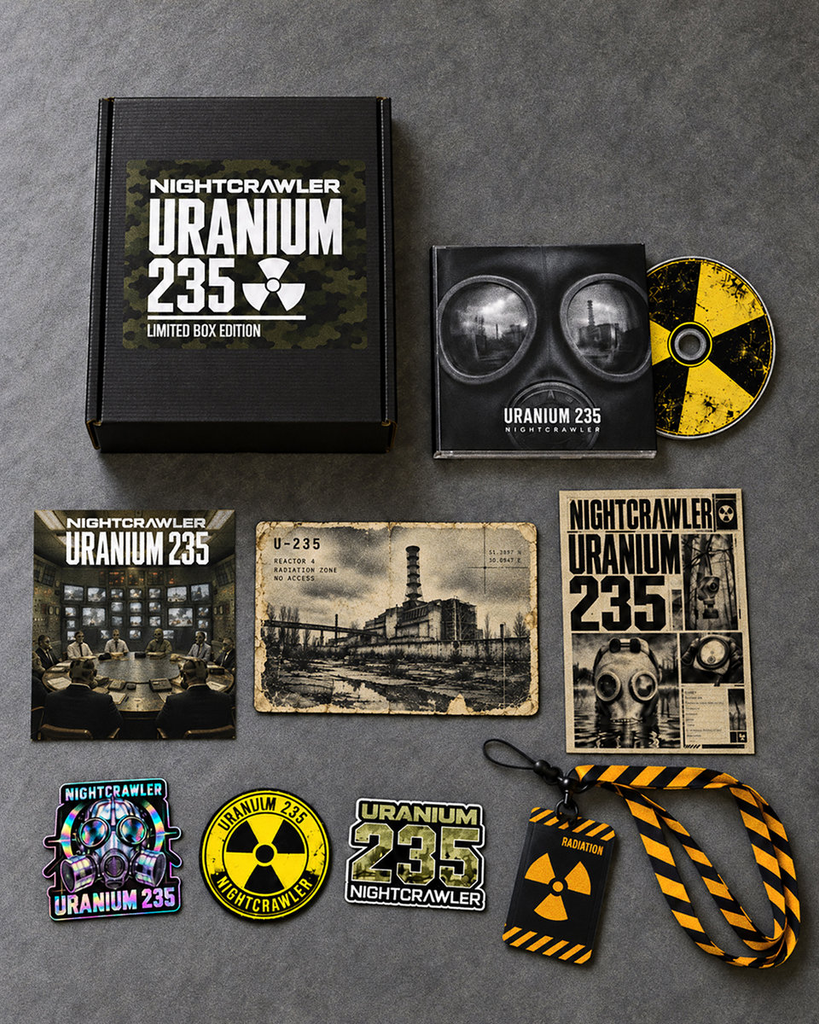
Uranium 235 is available on Bandcamp as a digital download, on CD in a four-panel digipack, and in a box limited to ten copies.