HUIR “States of Light”: emotion, resilience, transformation, liberation
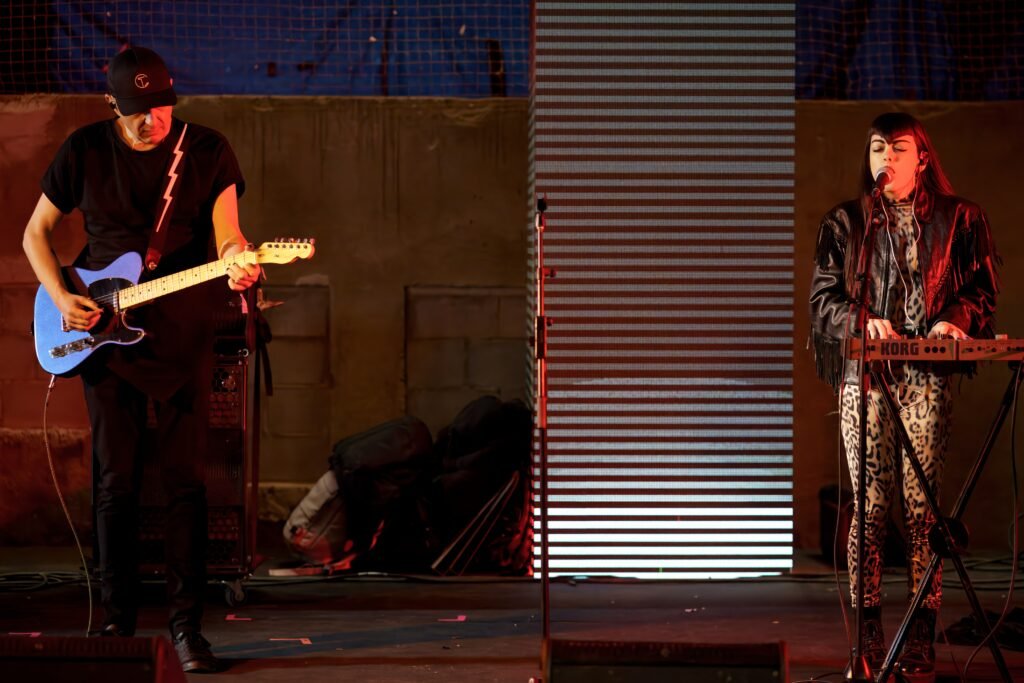
HUIR, the Barcelona duo of Ana Of The Head and David Solazo, released their debut full-length “States of Light” in May 2026. The record is built around a single decision that shapes everything else: side A carries the four new tracks, side B reprints “Triumphal Arch Lovers” in full, the EP the pair debuted with back in 2024. HUIR “States of Light” it’s a statement about where the project has been and where it’s headed, pressed onto the same piece of vinyl.
The vinyl as the argument
Combining a new record with an old EP on one release could easily read as padding. Here it doesn’t. The band frames “States of Light” as an exploration of four mental states, emotion, resilience, transformation, liberation, with light and darkness standing in as their symbols. It’s a conceptual pitch the scene has leaned on for decades, but HUIR earns it through pacing rather than rhetoric. No track drops below three minutes fifteen, and both “Storm” and “Arch” run past four and a half. Producer Maurizio Baggio, recording and mixing at his La Distilleria studio in Bassano del Grappa, gives every song room to develop before it resolves, and that patience does more work than the concept notes.
HUIR “States of Light”, track by track
Side A: the eighties turn
“Storm”, released as a single in November 2025, sets the tone. It opens on percussion that lands somewhere close to Jan Hammer’s “Miami Vice” score, before David Solazo’s guitar line takes over as the track’s real driving force. The synth bass is mixed with real care, and once the song builds toward its crescendo, that bass line starts arpeggiating, giving “Storm” a lift that a lot of album openers never manage.
“You”, complete with its own video, is currently HUIR’s most recognisable track and works as the obvious entry point for anyone new to the duo. Ana Of The Head carries it, moving between singing and near-spoken narration with a voice that fills the mix, backed by wordless “aahh” harmonies that pad out the space without crowding it. It sits closer to dark synthpop than the eighties pastiche of “Storm”, and it follows the same structural trick: the payoff arrives late, and the ending swings back toward the epic.
“Dreamers” is the most straightforwardly eighties track on the record: keyboards, drums and dark bass that occasionally recall Sisters of Mercy. That arpeggiated bass returns as the song’s most distinctive element, but vocally this is the least melodic cut on side A, leaning toward spoken delivery over sung hooks. It’s the track that resists immediacy the hardest, and the one that rewards repeat listens the most.
“Runaway” closes side A as the record’s ballad, if darkwave allows for the term. Slower tempo, melancholy running through both the arrangement and the vocal, built like the score to an eighties film set somewhere in Los Angeles. As a side-closer it’s the right call: after three tracks chasing scale, “Runaway” lets the record exhale before jumping back to 2024
Side B: “Triumphal Arch Lovers”, two years on
Revisiting “Triumphal Arch Lovers” confirms something debut EPs don’t always manage: the material holds up. Against the eighties-leaning new songs, the 2024 EP sounds like a more contemporary strand of darkwave, less anchored to a specific decade.
“Lovers” remains the track most people first heard from HUIR, and it’s easy to hear why. It’s melodic darkwave built around David Solazo’s guitar sitting alongside the electronics without friction, and a vocal from Ana that lands somewhere close to seductive. It’s no accident this was the track that got the duo an opening slot for Trisomnie 21.
“Triumphal” is the most repetitive, most fixed track on the record, held together almost entirely by a constant bass and percussion pattern. Nothing shifts until roughly a minute from the end, when David Solazo’s guitar enters and pulls the song in a different direction. It’s the clearest example of the logic running through the whole album: the surprises come late, and this is a record that asks to be heard start to finish.
“Vital” is the lightest track here, leaning openly into eighties synthpop and built for the floor more than the other seven songs. It does its job within the sequence, though on its own it’s the least essential thing HUIR have released.
“Arch” closes the record, and it’s the strongest thing on it. The synth bass turns melodic rather than purely functional, the keyboard enters to support it, and the guitar and vocal push toward shoegaze in the closing stretch. It’s the ending a record built as a physical object needed: epic without reaching for the obvious.
The Other Voices verdict
The real question this format raises is whether four new songs can justify sharing a record with an EP that already stood on its own. They can, though not evenly. “Storm”, “You” and “Arch” sit at the level of the best of “Triumphal Arch Lovers”; “Dreamers” matches it in a different register; “Vital” is the weakest of the eight tracks, functioning more as contrast than as a highlight. What makes “States of Light” work isn’t any single song, it’s how the object itself, side A against side B, EP against album, tells a story of continuity that few debut LPs pull off without forcing it.
Cold Transmission Music signing HUIR already carried weight before a single note played; the label’s catalogue has been built on a recognisable ear for this scene. “States of Light” backs that judgement up. It’s one of the strongest darkwave records of the year with an eighties pulse running through it, and it comes out of Barcelona.